
Pack the kitchen in a usable sequence
A kitchen holds fragile objects, dense cookware, food, sharp tools, and equipment with different preparation needs. Start by grouping those contents before buying materials or filling boxes. Decide what can be packed early and what the household still needs for simple meals. A staged plan allows you to finish the room without repeatedly reopening cartons to find a cup, pan, or utensil.
Walk through every cupboard, drawer, shelf, and pantry area. Include serving pieces stored elsewhere and appliances kept outside the kitchen. Identify items that will not move and arrange their appropriate destination. Keep decisions separate from packing so a box does not become a container for things you have not decided to keep. The inventory should reflect the kitchen you intend to use in the new home.
Choose a small daily use set and leave it in one clearly marked area. Include only what fits the household's meal plan until departure. Tell helpers that this group remains unpacked. Near moving day, transfer the remaining essentials to a personal arrival kit or a clearly identified final box, depending on when you will need access to them. Keep the packing plan visible to anyone helping. A clear instruction about what stays in use, what moves, and what remains with the property prevents decisions from being repeated at every cupboard.
Write a short meal plan for the remaining days before choosing the daily use set. If the household plans simple meals, you may need only a few ordinary utensils and containers. Keep those together and pack the rest in complete groups. This prevents the kitchen from remaining largely unpacked because one item in each cupboard is still useful. Review the plan when the schedule changes so the working set remains realistic until departure.
Gather materials suited to the contents
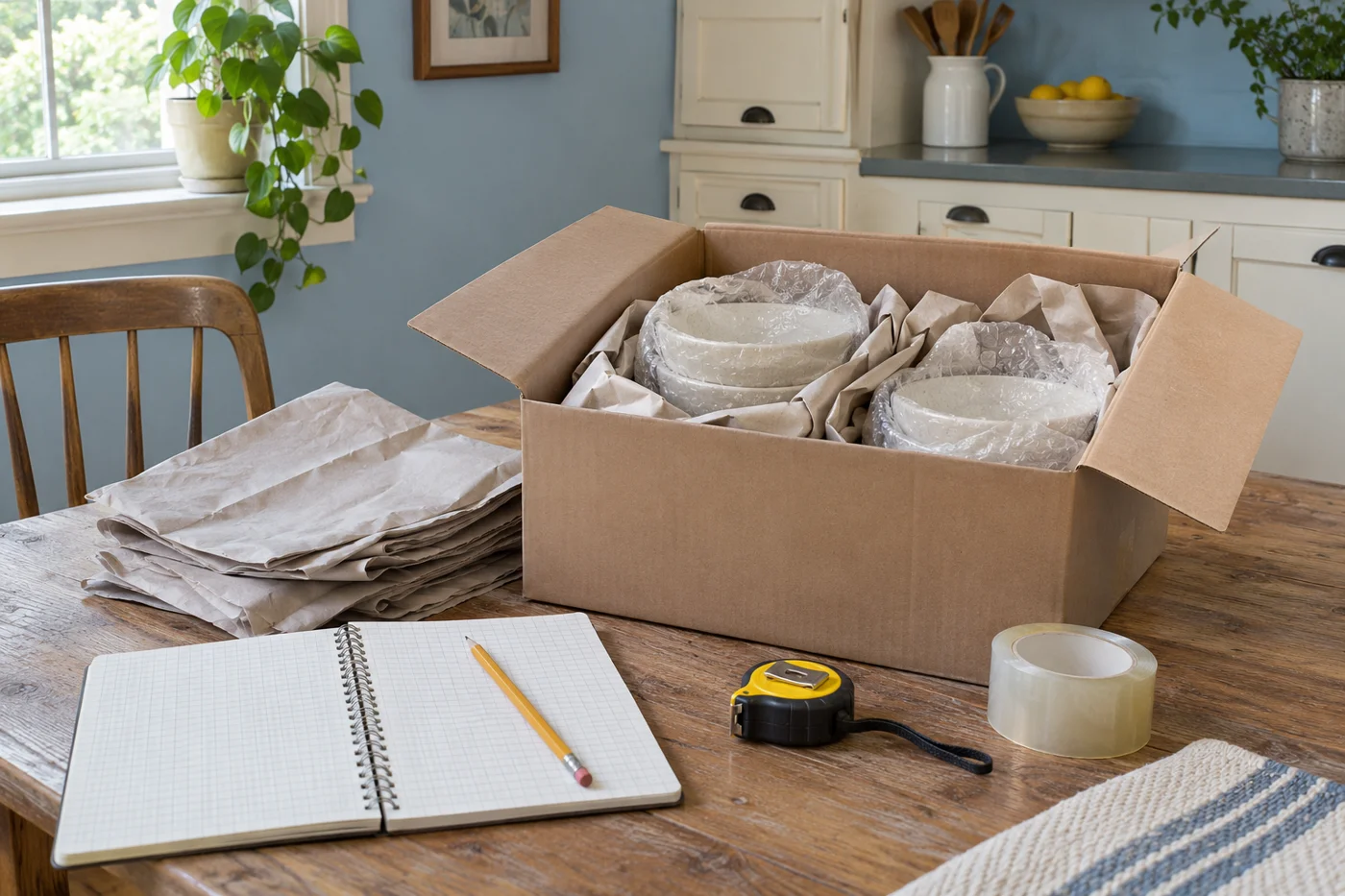
Use sound boxes in sizes that keep kitchen loads manageable. Dense cookware and dishes can make a large carton difficult to handle before it is full. Obtain appropriate wrapping and cushioning material for fragile items and enough tape to close the boxes securely. Inspect reused containers for weakened bottoms, moisture damage, and unreliable closures before placing anything valuable inside.
Set up a packing surface with room to wrap items without balancing them at the edge. Keep materials and finished boxes away from walking routes. If several people help, assign groups such as serving dishes or utensils and explain the labeling system. A clear work area reduces the chance that a fragile object is placed somewhere another person cannot see it.
Ask the mover about packing requirements and any items needing specialist preparation. If you have unusually delicate, valuable, or large pieces, describe them before the packing day. Ordinary supplies may not be suitable for every object. Use manufacturer or specialist guidance where relevant instead of assuming the same wrapping method works for a glass bowl, a small appliance, and a fragile collectible.
Sort before wrapping every object
Review duplicates, damaged utensils, unused gadgets, and serving pieces that no longer suit the household. Decide what you want in the destination kitchen. Consider available storage and the equipment already provided there. Moving an item requires packing, carrying, unpacking, and a place to keep it, so an early decision can remove work at several stages.
Arrange donation or disposal through appropriate local services and confirm what they accept. Keep those items away from packed shipment boxes. Food, electrical equipment, and broken objects may have different acceptance rules. Do not assume a collection service takes every kitchen item or that the movers will remove unwanted belongings without an explicit agreement.
Keep uncertain items in a small decision area with a deadline. Avoid allowing that area to spread through the kitchen. If another household member owns or uses the item, ask before discarding it. Once the decision is made, update the inventory and either pack the object or complete its planned removal. A label saying donate does not finish the task while the item remains in the home.
Pack dishes with individual protection
Inspect dishes and note existing damage before wrapping significant pieces. Use suitable material to separate fragile surfaces and protect them from movement. Choose a container that supports the items and allows cushioning around the group. Follow the moving provider's packing guidance for your particular dishes and cartons. Avoid relying on an exterior fragile label to compensate for loose contents inside.
Keep the box manageable and prevent items from shifting into each other. Fill remaining spaces with suitable cushioning, without forcing the lid closed or placing pressure on delicate parts. Check the box before sealing. If the contents can move freely, revise the packing rather than assuming careful carrying will prevent contact throughout the journey.
Label the destination and identify the group in a private contents list if useful. Use a simple box number so similar cartons can be distinguished. If a valuable set needs special handling, discuss that with the mover and document the relevant instructions. Keep an arrival set separate if you need dishes before the shipment is unpacked.
Pack a small test group before wrapping an entire collection if the materials or box arrangement are unfamiliar. Check whether the pieces remain separated and the container closes without pressure. Ask the moving provider for guidance when the result is uncertain. Repeating an unsuitable method across several boxes makes correction harder later. A careful first check helps you use the available supplies appropriately and identify whether a different container or professional packing service is needed.
Give glasses and delicate shapes their own attention
Glasses, stemware, and other thin or irregular shapes need protection appropriate to their design. Separate individual pieces and avoid pressure on stems, handles, rims, or other vulnerable parts. Use suitable containers and packing materials, including specialty packaging when appropriate. Ask the mover or a qualified packing service about objects you cannot prepare confidently with the materials available.
Do not use a fragile glass as storage for loose objects simply because it has empty space. The packing should protect the shape rather than create contact points that can damage it. Keep groups consistent enough to arrange securely. If a box contains several different shapes, assess how they could interact when the carton is carried, stacked, or moved.
Retain original protective packaging when it remains suitable and complete. A retail box without its supporting inserts may not provide the protection you expect. Inspect the full arrangement before relying on it. Label the carton clearly and keep it within the provider's handling requirements. For irreplaceable pieces, discuss whether professional packing or a separate arrangement is appropriate.
Keep cookware and utensils manageable
Group pots, pans, baking trays, and other cookware according to size and weight. Protect surfaces that could rub or scratch, and keep lids associated with the correct item. Avoid creating one extremely heavy box simply because the pieces nest efficiently. A compact arrangement still needs to be carried and placed safely during the move.
Sort ordinary utensils into useful groups and contain loose pieces so they do not scatter inside the box. Keep serving utensils distinct from the small daily use set. Label removable parts and accessories that belong to particular equipment. A clear group is easier to unpack than a mixed drawer emptied into a carton without any separation or description.
Secure sharp items using appropriate protective packaging so edges cannot become exposed during handling or unpacking. Keep them away from children and identify the contents clearly for the adult opening the package. Do not leave loose knives among towels or ordinary utensils where someone could reach without seeing them. Follow suitable product guidance for specialized blades or equipment.
Prepare small appliances by their instructions
Clean and dry small appliances before packing, following the manufacturer's guidance. Remove or secure detachable parts as directed and keep them labeled with the correct machine. Protect delicate components and avoid placing strain on controls or protruding pieces. If original packaging is suitable, use the complete arrangement rather than assuming the outer carton alone is sufficient.
Label cords and accessories so you can reconnect the correct parts after arrival. Do not force cords around a component in a way that could damage it. Retain instructions for equipment with an unfamiliar assembly or startup procedure. If a machine has particular transport requirements, follow them and discuss any concern with the moving provider before it enters the shipment.
Keep appliances needed immediately in an accessible group only if that fits your travel and arrival plan. A large collection of kitchen equipment can overwhelm the first night kit. Decide what you actually need for simple meals and leave the rest for ordinary unpacking. Confirm the destination has suitable service and space before planning to use equipment there.
Keep accessories for similar appliances distinguishable. Two detachable cords, lids, or mixing parts can look alike while belonging to different equipment. Use a clear label tied to the model or item name and place the group with its machine where appropriate. Avoid relying on memory after several days of travel and unpacking. A simple association made during packing can prevent a frustrating search or an incorrect assembly when the household is ready to use the appliance again.
Treat major appliances as separate preparation tasks
A refrigerator, dishwasher, range, or other major appliance may require preparation beyond ordinary packing. Confirm whether it is part of the move and whether the provider accepts the specific item. Follow manufacturer instructions and arrange qualified help for disconnection, installation, or other work outside your competence. The moving crew should not be assumed to perform those tasks unless its agreement explicitly includes them.
Schedule preparation so the appliance is ready before loading. Ask what condition the mover requires and who supplies any necessary protective or transport parts. Keep the instructions and model information accessible. If the destination has different connections or space, resolve those questions before paying to transport an appliance that cannot be used as planned.
Measure the item and carrying route at both addresses. Include doors, turns, stairs, and the intended position in the new kitchen. Ask the provider to assess difficult access. Do not improvise a lift or remove unfamiliar building components to force the appliance through. An appropriate handling plan should be agreed before moving day, with clear responsibility for each stage.
Make a separate plan for food
Review pantry and refrigerated contents early. Decide what can be used before departure, what can be donated through an accepting organization, and what requires appropriate disposal. Ask the mover about its food acceptance policy. Do not assume all sealed items are accepted or that food can travel safely under every transport and storage arrangement.
Plan meals around the time remaining and the kitchen equipment still available. Avoid buying a large grocery supply immediately before the household loses ordinary storage or cooking access. For anything you carry personally, use an appropriate transport and storage arrangement for that item. If you cannot maintain the required conditions, choose another safe plan rather than treating the move as an exception.
Keep food separate from cleaning products and other materials that could contaminate it. Label the personal meal group clearly and assign someone to manage it during travel. The food plan should fit the actual journey and any delivery gap. A long household goods shipment is a different situation from a short trip with suitable personal supplies.
Label boxes for useful unpacking groups
Use destination labels that help the receiving household, such as kitchen dishes, cookware, or baking equipment. Add a simple identifier to distinguish boxes in the same group. Label more than one side so the information remains visible when cartons are placed together. Keep valuable contents in a private inventory rather than prominently describing them on the outside.
Mark the limited early access group separately. That label should reflect contents you actually need soon, not every kitchen box. If everything says open first, the instruction stops helping. Keep a short list showing which container holds the everyday dishes, basic utensils, or other chosen essentials. Put that list where you can reach it before opening the shipment.
Ask helpers to use the same names and numbering convention. If the destination has a pantry or separate dining storage, make the distinction clear. A box sent directly to its intended area saves later searching and carrying. The labeling system should remain simple enough that a person who did not pack the kitchen can still place the containers correctly.
Finish the last kitchen work deliberately
Before loading day, check every drawer, cupboard, and appliance storage area. Look for items drying on racks or set aside during cleaning. Pack the remaining daily use group according to the arrival plan. Keep necessary cleaning supplies accessible until the property handover work is finished, while following the provider's restrictions on what can enter the shipment.
Confirm that any appliance preparation appointment is complete and that the mover has the current instructions. Separate belongings staying with the property and point them out during the walkthrough. A crew cannot infer which appliance belongs to a landlord or which countertop item the household intends to carry personally. Clear boundaries prevent unnecessary loading and later retrieval.
Keep pathways open and move finished boxes only to suitable staging areas. Avoid stacking heavy kitchen cartons above fragile or unstable belongings. Let the moving provider handle the load according to its plan. Before leaving, inspect the kitchen once more and complete property obligations through the relevant agreement, keeping those records separate from the shipment inventory.
Unpack into a working kitchen first
Begin with the limited set needed for simple meals and washing. Check the condition of fragile items as they are unpacked and preserve relevant packaging if a concern appears. Keep box identifiers associated with any issue you need to report. Follow the mover's documented process and check applicable requirements directly rather than relying on a remembered deadline.
Place cookware, utensils, and small appliances according to how the new kitchen will be used. Avoid filling every cupboard simply to empty cartons quickly. Confirm that shelves and storage spaces are suitable for the load. Use manufacturer guidance and appropriate help for appliance setup. An unfamiliar connection or unsafe condition should be resolved before equipment is put into use.
Keep empty materials away from exits and remove personal information from labels before disposal. Retain useful supplies only if there is a practical place and purpose for them. Once everyday cooking works, finish the less urgent groups and review items still awaiting a decision. The aim is a usable kitchen with belongings you can find and handle comfortably.
As you unpack, check the private contents list against the boxes received. If something is missing, look in the related group before opening unrelated rooms. Ask household helpers where they placed uncertain items during the final packing session. Keep the search organized and update the record when an item is found. This reduces duplicate searching and helps distinguish a misplaced utensil from a genuine shipment question that needs to be raised with the provider.